

The innovative PALLAS (Prototyping Accelerator based on Laser-pLASma technologies) project at IJCLab (Laboratoire de Physique des 2 Infinis Irene Joliot Curie) has successfully produced its first electron beam, marking an important milestone in the commissioning process.
Developed through a collaboration between CNRS / IN2P3, IJCLab, LLR, LP2IB, and Université Paris-Saclay, the PALLAS experimental facility explores laser-driven plasma wakefield acceleration — a breakthrough technology that could one day lead to smaller, more powerful, and cost-effective particle accelerators.
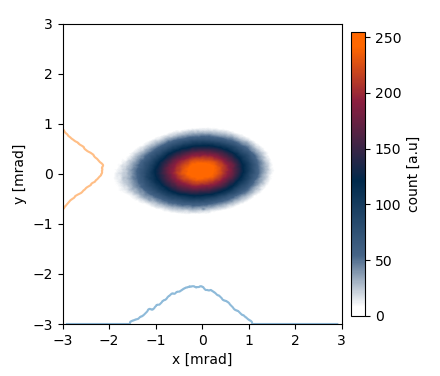
During its first test run in early summer, the PALLAS team accelerated electrons to 160 mega-electronvolts (MeV) using a plasma cell only a few millimetres long. This achievement represents a world first, as the team successfully generated an electron beam within a compact double gas-cell target directly integrated into the accelerator beamline — pushing the limits of laser-plasma accelerator miniaturisation.
“This result is a first important milestone on the path to developing compact laser/plasma-based accelerators at IN2P3 and IJCLab after years of dedicated and intense work of all involved groups, especially after the flood of October 2024” explains Kevin Cassou, PALLAS project manager at IJCLab.
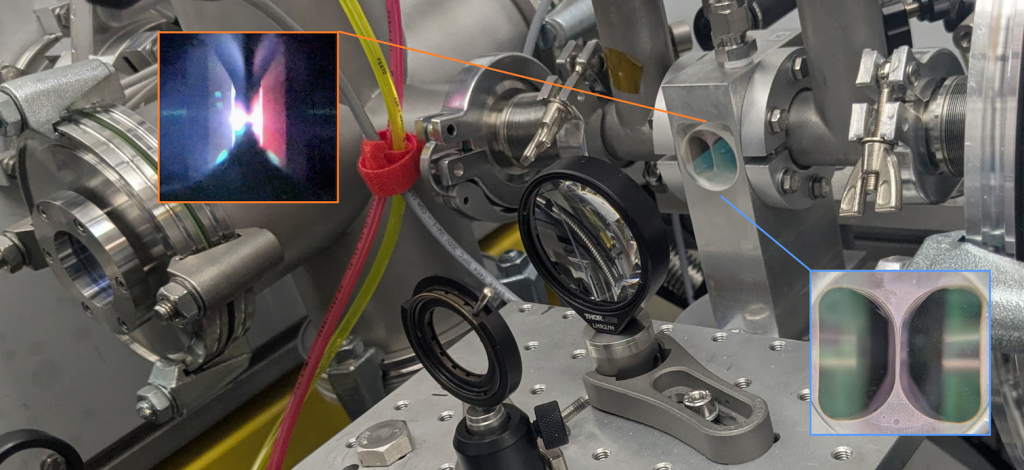
In this initial start-up phase, the gas volume in which the accelerating structure is generated consists of a double cell developed and built at the laboratory. This setup makes it possible to control and shape the gas density profile as well as the composition of the gas mixture. Beyond the quality of the laser beam that creates the plasma and the wakefield, the electron density profile of the plasma and the species composition must be precisely controlled over sub-millimetre scales for this injector.
This milestone marks the beginning of the commissioning phase of the PALLAS injector. In the coming months, the facility will undergo further upgrades to the LASERIX high-energy laser amplifier at Université Paris-Saclay. Future efforts will focus on laser stabilisation and fine control of the electron beam’s properties to enhance beam quality and reproducibility. To achieve this ambitious goal, a collaboration with Amplitude Laser has started in April 2025.
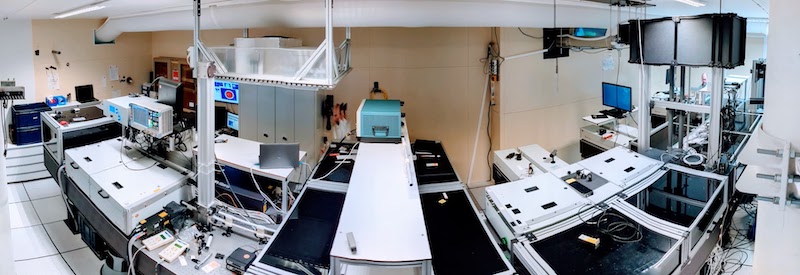
The LASERIX laser platform delivers ultra-short, high-intensity pulses with a peak power of 50 terawatts. Each pulse lasts just 40 femtoseconds (40 quadrillionths of a second) and propagates through a mixture of helium and nitrogen gas, forming a plasma where electrons are expelled from high high-intensity region of the laser pulse, creating a plasma wake where some electrons can be trapped are accelerated — similar to a wakeboarder riding the wave behind a boat. During the current commissioning phase, LASERIX operates at 1 Hz and is expected to reach 10 Hz within the next year.
Although laser-plasma acceleration is still at an early stage, its potential is enormous. These accelerators can achieve acceleration gradients up to 1,000 times higher than those of conventional radiofrequency (RF) accelerators, paving the way for more compact and accessible accelerators for fundamental research, medical applications, and industrial technologies. Continued research and development on dedicated facilities like PALLAS are essential to bring this technology closer to maturity and, in particular, to improve the stability and quality of beams produced by laser-plasma accelerators.
The PALLAS project is also taking part in the development of EuPRAXIA, a major European initiative on the ESFRI roadmap aimed at developing two innovative plasma accelerator EUV FEL facilities in Frascati (EuPRAXIA@SPARC_lab – INFN-Italy) and ELI-Beamlines (Czech Republic).